A scenario repeated in thousands of establishments: a playlist from a personal streaming service account, connected to a speaker via Bluetooth, plays in the dining room. The music plays, the guests are happy, everything works—until a visit from a representative of the Russian Authors' Society (RAO) or a letter with a pre-trial claim. Then comes court, and the costs are unpleasant: according to the Civil Code, compensation for copyright infringement starts at 10,000 rubles per piece. The claim typically lists several tracks from a single visit—the bill quickly runs into the hundreds of thousands. We'll explore how the system works and how to play music in a venue without any problems.
Why can't I just turn on my playlist?
Music played in a cafe, store, or salon is legally considered a "public performance," requiring payments to copyright holders. Your personal subscription to a streaming service doesn't help here twice. First, any streaming service's user agreement only permits personal listening—business use is expressly prohibited, meaning you're violating the service's contract. Second, a subscription doesn't relieve you of the obligation to pay for public performance: these fees are administered by two organizations.
- RAO collects remuneration for authors - composers and poets.
- WIPO collects for performers and phonogram producers.
These are two different payments for the same music, and inspectors come from both organizations. The process is simple: a representative records several tracks playing on video, identifies the copyright holders, and the establishment receives a complaint. The excuse "it was the radio playing" also doesn't work: rebroadcasting a song in a commercial space is the same as public performance.
Three legal ways to play music in a venue
1. Agreements with RAO and VOIS
The classic route: you sign contracts with both organizations and pay a fee based on the type of venue, its size, or the number of seats. In exchange, you play virtually any popular music. Cons: two contracts, two payments, reporting, and significant costs for a small venue. Pros: complete freedom in choosing your repertoire, including international hits.
2. Background music services for business
There are specialized services that license music for commercial use directly from copyright holders. Their catalogs are already "cleaned," and there's no need to pay RAO and VOIS: a single subscription fee covers the entire issue. These services typically include pre-made playlists tailored to the venue's format, a schedule (quieter in the morning, more dynamic in the evening), and centralized management for networks. A downside: their catalogs typically lack the latest radio hits—but for background music, this is often a plus rather than a minus: the purpose of background music is to create an atmosphere, not a concert.
3. Music under free licenses
Tracks distributed by the authors under open licenses permitting commercial use are free of charge. This method works, but it's labor-intensive: a high-quality selection must be compiled and updated manually, carefully reading the terms of each license, and the quality of the material is uneven. It's suitable as a temporary solution or supplement, but building a network's musical accompaniment on this approach is a questionable time-saving measure for the manager.
The second half of the question: what does it play through?
A legal source is half the battle. The other half is the equipment, and here the "phone plus Bluetooth speaker" fails on all counts, not just legally. Bluetooth breaks when the phone is taken to the back room; the battery dies by Friday evening; one speaker blares at the nearby tables and is inaudible in the far corner; and when an employee turns on their playlist, the establishment's concept becomes a lottery.
A professional background voice system solves this once and for all:
- Stationary source in the equipment rack: A music service player or playlist player operates on a schedule automatically—without phones, batteries, or human intervention.
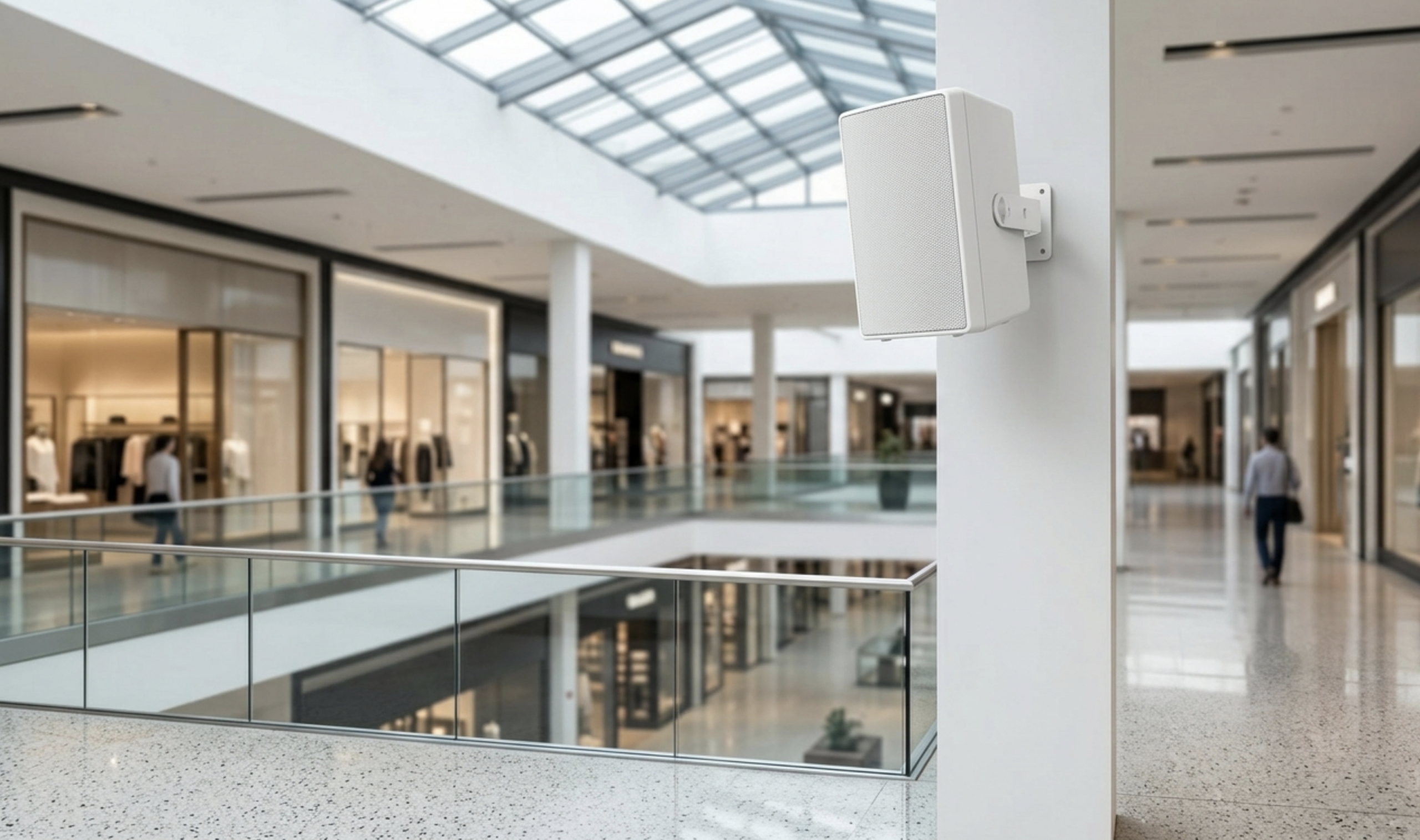
- Uniform sound throughout the hall: Several ceiling or wall speakers instead of one loudspeaker - music can be heard everywhere and does not interfere with conversation.
- Zoning: The hall has a playlist, the restrooms are quieter, and the summer veranda has its own volume control. Staff announcements can be heard over the music if needed.
- Control without a specialist: Volume and scenarios - from the wall panel or the administrator's tablet, with one button.
Checklist: Check your establishment
- Is the music playing from a personal streaming account or "from the radio"? — There's a risk of a claim on any workday.
- Do you have contracts with RAO and VOIS, or a subscription to a business service with cleared rights? — If you don't have either, there's no legal basis for music in the hall.
- Is the sound source an employee's phone? — So, the repertoire and volume each evening depend on their taste and battery life.
- Guests at the back of the room are asking for "louder sounds," while those at the bar are asking for "quieter sounds"? — The problem isn't the volume, but the speaker placement.
How to do it right the first time
You decide the legal aspect—choosing between contracts with RAO/VOIS and business services—based on your establishment's format and budget. We handle the technical aspects: designing and installing the systems. background sound for restaurants and cafes, shops and supermarkets и shopping centers — with uniform sound, zoning, and a source that can be easily installed by any legal service. Installation is done overnight and before opening, so the establishment doesn't lose a day of work. An engineer's visit and site inspection are free.
 RU
RU