RU
RU
Mall background audio
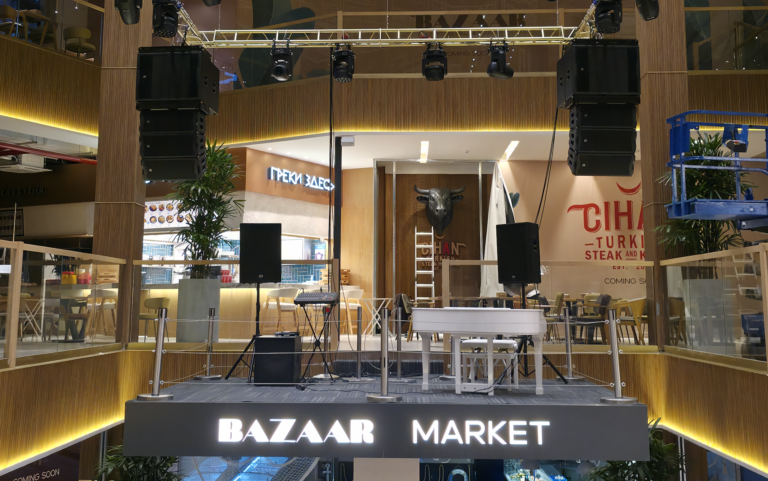
Design and installation of Public Address systems for shopping centers of all sizes. We create uniform sound coverage to increase customer dwell time and integrate the system with the sound system.
Design and installation of Public Address systems for shopping centers of all sizes. We create uniform sound coverage to increase customer dwell time and integrate the system with the sound system.

We offer only professional systems, including both complete systems and standalone equipment for background sound in shopping and entertainment centers.
Full cycle: from acoustic calculations to facility delivery
Selection of optimal hardware and direct delivery of professional equipment to the site.
Performing precise acoustic calculations and drawing up detailed cable route layout diagrams.
Laying out low-current networks and physical installation of loudspeakers and amplifiers.
Sound zoning, fine equalization and mandatory integration with public address systems (PAS).
We train administrators and the operations team to manage zones, volume, and the launch of announcements.
Technical support, warranty and post-warranty repairs at our own service center.
By working with Puskonaladka, you gain a partner who understands the specifics of large retail facilities.
We design systems focused on marketing and comfort. Music in shopping malls should sell and engage visitors, not just blare away somewhere upstairs.
Any breakdown is repaired promptly. We offer an extended warranty and a replacement fund for the duration of the repair.
Our background sound system can receive a control signal from your fire alarm so that the music is immediately muted when an alarm occurs.
| Engineer's visit and preliminary assessment | For free |
| Design with acoustic calculations | from 50,000 rubles. |
| Installation (per installation point) | from 1000 rubles per point |
| Turnkey sound system for a shopping mall« | according to the project |
The cost of the solutions includes equipment, installation, and setup. A precise estimate is provided after a site inspection, confirmed before work begins, and remains unchanged throughout the process.
Providing sound reinforcement for a shopping center is an engineering challenge, managing the sound field across thousands of square meters. A shopping center's sound reinforcement system is built on three principles:
A shopping and entertainment center is a complex facility with multiple zones and broadcast types, so we always calculate background sound for a shopping center based on a custom design, with a preliminary on-site visit by specialists to develop precise specifications.
We select sound reinforcement equipment for shopping centers based on the budget and facility class. After installation, we perform commissioning: we configure a uniform sound field, set comfortable volume levels by zone, and train staff in system operation.
Many contractors offer shopping center sound systems using inexpensive sound systems, but they don't create the same effect as an expensive boutique or a cozy restaurant. We have a sufficient staff of high-rise installers and engineers to handle projects ranging from 1,000 to 100,000 square meters: we'll develop a design, supply equipment, and launch a commercial sound system right in time for your shopping center's opening.
No, and they shouldn't be confused. The fire alarm system is a certified security system with narrowband alarms; it's designed according to fire safety standards and operates autonomously. The shopping center's background sound system is a comfort system with broadband music. We connect them via a priority channel: when the fire alarm is triggered, the music is immediately muted, and the fire alarm system receives the broadcast.
Yes. The service announcement system allows you to launch targeted advertising and informational videos: food court promotion announcements are broadcast only in the food court, store announcements are broadcast in its gallery, and general announcements are broadcast throughout the shopping center. The video schedule is configured in the scheduler, and staff manages the broadcast without involving technical specialists.
Yes, this is standard practice. Installation is carried out at night and during utility windows before opening: laying cables behind the ceiling, installing speakers, and wiring. During the day, there are no traces of the work, and tenants and visitors are not harmed. The nighttime schedule increases the timeframe, but the shopping center does not lose a single day of revenue.
Ideally, this should be done at the "concrete shell" stage, before the ceilings are covered and the finishing is complete. Then, the cable routes are coordinated with the ventilation and electrical systems, and installation is significantly cheaper. If the shopping center is already finished, this is also possible: we can use the ceiling space and cable ducts to match the interior color, but the budget and timeline will be higher.
A typical layout includes galleries, a food court, an atrium, restrooms, parking, and utility areas—from 4 to 10 or more zones depending on the area and layout. Each zone has its own volume level and content, and control is consolidated onto a single console or administrator tablet. The exact zoning is determined during the design process.